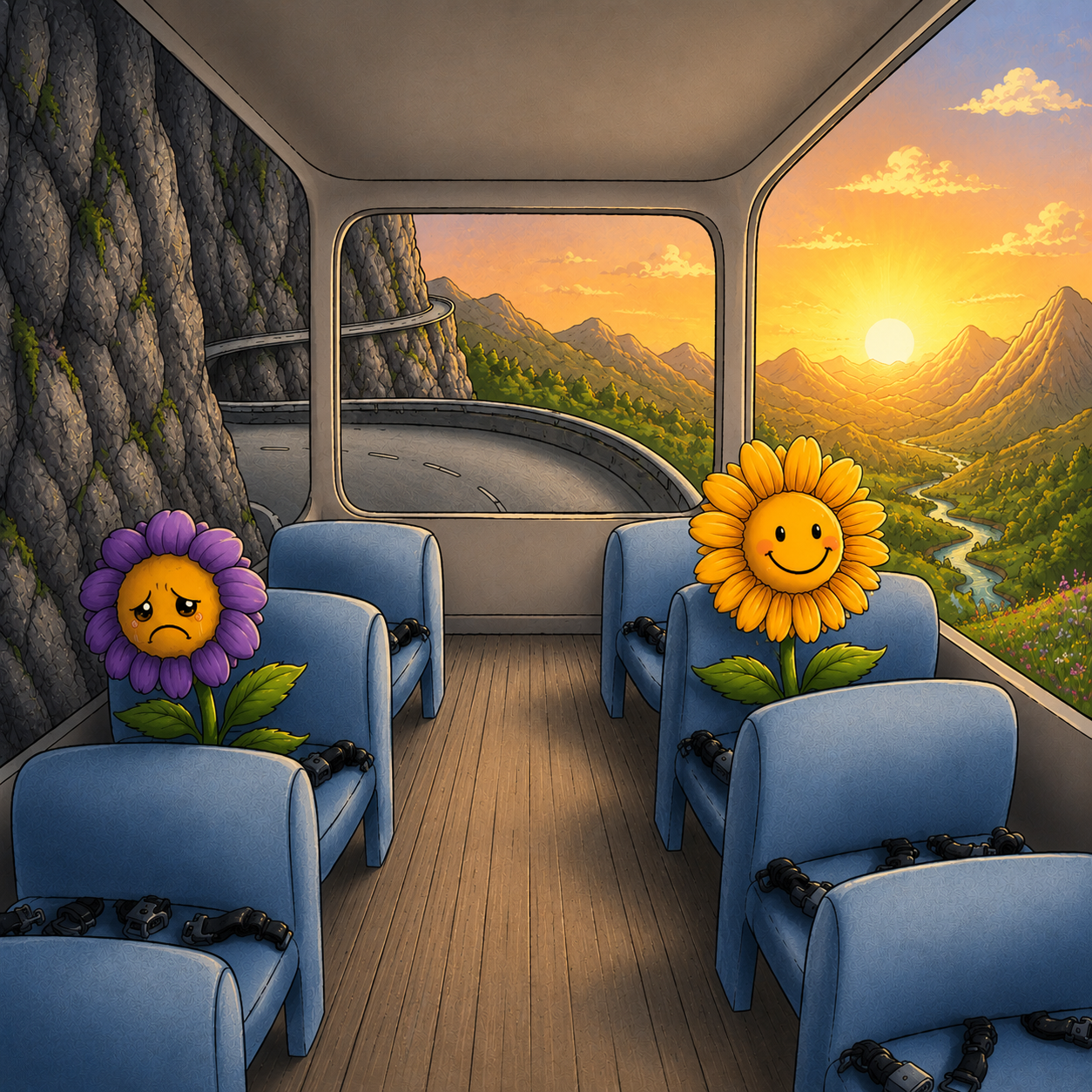
The Rock-Side Window
From this seat, the obstacle may fill the entire view.
It may feel permanent, unavoidable, or larger than everything else around it.
This view is not imaginary. It is simply one view from one seat.
A Sassiverse Way of Looking Around
The seat you are in may be real. It may be difficult. It may not be the only seat on the bus.
Sunny Seats are a way of noticing that another view, response, possibility, or path may exist, even when the one in front of us is the only one we can currently see.
Look Around the BusMore Than One Window
Imagine riding on a bus beside a rock wall.
From your seat, the rock fills the entire window.
It may feel as though the whole journey is nothing but stone.
But across the aisle, another window may show trees, sky, sunlight, water, or an open road.
The rock outside your window is real.
The other view may also be real.
A Sunny Seat is another place from which a choice, response, possibility, or path may become visible.
Sunny Seats do not tell us which choice to make.
They simply help us remember that the first choice we can see may not be the only one.
When One View Fills the Bus
Sometimes we become so focused on one outcome, one response, one fear, or one version of the future that other possibilities disappear from view.
We may believe there is only one way forward.
We may believe there is only one way to respond.
We may believe the way we have always acted is simply who we are.
We may not realize that waiting, asking, speaking, resting, learning, leaving, returning, adapting, or trying something unfamiliar could also be seats on the bus.
Sometimes another seat exists before we are ready—or able—to see it.
Not seeing another option does not mean we are foolish.
It may simply mean that the rock has filled our view for a very long time.
The Same Bus, Different Windows
From this seat, the obstacle may fill the entire view.
It may feel permanent, unavoidable, or larger than everything else around it.
This view is not imaginary. It is simply one view from one seat.
Another seat may reveal a different response, resource, boundary, possibility, or direction.
The road may still be difficult.
But more of the landscape may become visible.
The rock may be real, and it may matter deeply.
It may not be the only window on the bus.
A Gentle Invitation, Not a Demand
Some seats are connected to hopes, dreams, relationships, identities, losses, and futures we imagined for a long time.
Looking away from the rock may feel painful.
Another path may exist without feeling like the path we wanted.
Seeing another choice does not erase grief, disappointment, anger, fear, or longing.
Sunny Seats are not a command to move faster than we are ready to move.
Seeing another choice does not make the original loss less real.
Sometimes the first step is not changing seats.
Sometimes it is simply noticing that another seat exists.
Looking for What Is Still Yours
We do not control every road, passenger, obstacle, delay, or turn.
We may not control every thought that arrives, but we may notice which thoughts we continue feeding, questioning, or carrying.
We may have choices in how we speak to ourselves, how we speak to others, and which words help make the moment clearer.
We may choose to pause, ask, answer, practice, adapt, begin, stop, return, seek support, or take one small step.
We may decide what we participate in, what we step away from, and what requires more space, clarity, or care.
Asking a question, seeking another perspective, or letting someone sit beside us may reveal seats we could not see alone.
Choosing not to decide yet may also be a seat. Some views become clearer when we stop demanding an immediate answer.
Small Choices, Different Views
Sunny Seats may appear in ordinary moments, long before we give them that name.
“They said something hurtful, so I have to answer immediately.”
“I may answer now, wait, ask a question, name a boundary, or choose not to continue the conversation.”
“I have always reacted this way. This is simply who I am.”
“This may be a familiar response, but I may be able to practice another one.”
“I missed my chance, so there is nowhere else to go.”
“That path may be closed, and another path toward something meaningful may still exist.”
“I do not know the perfect next step, so I cannot move.”
“I may not know the full route, but I may be able to choose one small next step.”
“There are only two choices, and both feel impossible.”
“There may be another seat I have not seen yet, or someone who can help me look.”
Companion Practices
They are connected, but they do different things.
A Sunny Spot may offer movement, comfort, creativity, rest, connection, or somewhere softer to look.
It helps create enough space to see more than the rock.
A Sunny Seat helps us notice another response, resource, boundary, possibility, direction, or path.
It reminds us that the first view may not be the only view.
A Sunny Spot may help you look around. A Sunny Seat may help you notice where you could go next.
Words for Looking Around
Sometimes we are not ready to make a choice.
Sometimes we only need language that helps us remember choices may exist.
This may not be the only seat.
This may not be the only window.
I may not be able to see every path yet.
I can look for what still belongs to me.
I may ask someone to help me look around.
I do not have to move before I am ready.
I can begin by noticing that another seat may exist.
The first act of choice may simply be realizing that a choice is present.
Looking Together
When one window has held our attention for a long time, it may be difficult to imagine what anyone could see from the other side.
Another person may notice a resource, question, option, strength, boundary, or path that has disappeared from our view.
They do not have to choose the seat for us.
They may simply help us notice that it is there.
Sometimes borrowed perspective works a little like borrowed belief.
Someone else can hold open the possibility of another view until we are ready to look for ourselves.
The Bus Keeps Moving
A seat that once helped us may stop fitting.
A response that protected us in one season may feel different in another.
A path we could not see before may become visible later.
We may move, return, pause, or discover that the seat we need today is not the seat we expected to choose.
Looking around is not a one-time decision.
It is something we may practice throughout the journey.
The rock outside your window may be real.
The view may be difficult.
You may not be ready to move.
You may not know which path you would choose.
You do not have to force an answer.
For now, you may simply look around the bus.
Continue Your Journey